
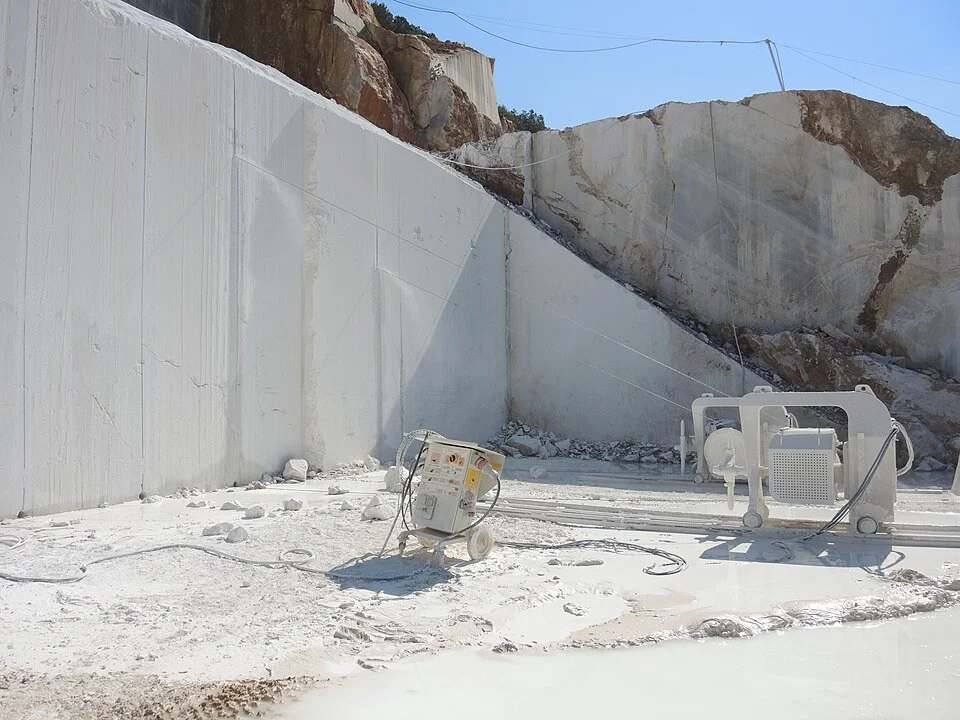
How diamond wire cutting works
A diamond wire is a continuous cutting loop built from three working parts: a high-strength steel carrier rope, diamond beads, and an assembly that spaces and secures the beads. The machine tensions and pulls the loop around drive and guide pulleys. As the beads move through the cut, the diamond and metal bond abrade the stone.
The carrier rope does not perform the cutting, but it carries the load that keeps the beads moving. Its construction, diameter, tensile properties, galvanizing, and splice must match the machine and duty. Rubber or plastic injection helps hold the beads and protect the rope from slurry and abrasion. Spring assemblies remain available for some softer-stone applications.
Water commonly cools the cut and carries away fines. Some suppliers also make dry-cut wires for specific limestone applications. Treat that as a product-specific capability, not a default for every stone or machine.
Quarrying and dimension-stone mining
In a quarry, diamond wire is used to open benches, make primary cuts, free blocks from the rock mass, and square blocks before transport. A typical setup threads the wire through intersecting drill holes, closes it into a loop, and routes it around the machine’s drive wheel and guide pulleys. The machine then draws the wire through a gradually advancing cut.
This is the clearest mining application: controlled extraction of saleable dimension-stone blocks. Diamond wire is widely used with marble and granite and is also offered for limestone, sandstone, travertine, quartzite, and other natural stone. It should not be treated as a universal replacement for drilling, blasting, or mechanical excavation across all mining operations.
The wire must be matched to the quarry. Stone mineralogy and abrasiveness affect bead bond, grit, concentration, feed, cooling, and expected wear. Suppliers may request a stone sample or operating history before recommending a formulation.
Block squaring, profiling, and slab cutting
After extraction, single-wire machines are used to square irregular blocks, trim faces, and cut profiles. The flexible wire path makes the method useful where a circular blade would be limited by diameter or geometry.
Multiwire machines run many parallel diamond wires to turn a block into slabs. Compared with quarry wire, multiwire assemblies generally use smaller supporting ropes and smaller beads because the machine carries multiple closely spaced loops. The goal is consistent slab thickness and uniform cutting across the full block.
A buyer should specify whether the wire is for quarry extraction, stationary single-wire work, profiling, or multiwire slabbing. A wire quoted for one duty may not be suitable for another even when the stone is the same.
Match the wire to the stone and machine
| Buying factor | What to confirm | Why it matters |
|---|---|---|
| Stone | Marble, granite, limestone, sandstone, travertine, quartzite, engineered stone, or another material | Bond, diamond formulation, speed, feed, cooling, and wear behavior change with the material |
| Application | Bench cut, block freeing, squaring, profiling, or slabbing | Quarry, single-wire, and multiwire machines use different wire geometries |
| Carrier rope | Construction, diameter, tensile requirement, galvanizing, and minimum breaking requirement | The rope carries tension and bends around the pulley system |
| Diamond beads | Sintered or electroplated; diameter, bore, grit, concentration, and bond | The bead formulation controls cutting action and wear |
| Assembly | Rubber, plastic, or spring; open or closed loop; splice method | The assembly holds spacing and protects the carrier rope |
| Machine | Make/model, pulley diameters, power, speed range, tension system, and cut dimensions | Tool geometry and operating limits must be compatible with the machine |
Supplier examples show why the application must be stated. Dellas lists quarry configurations with a 4.9 mm supporting wire, 10.5–11 mm beads, and 27–40 beads per meter. Its multiwire examples use a 2.35–3.5 mm supporting wire, 5.3–7.2 mm beads, and 37 beads per meter. These are examples from one manufacturer, not universal specifications.
For more detail on the steel component inside the assembly, see Mati’s guide to hot-dip galvanized steel wire rope. Fine-wire carrier rope may be electro-galvanized unless the buyer explicitly requests the process and coating requirement.
Performance depends on the whole cutting system
There is no single wire speed, tension, feed rate, water flow, or service-life figure that applies across quarry and plant work. Stone properties, machine rigidity and power, pulley geometry, cut length, bead formulation, carrier-rope condition, and operator setup all interact.
Research on granite wire sawing identifies vibration, poor wire rotation, eccentric bead wear, wire breakage, and unsatisfactory tool life as linked problems. Pre-twist helps rotate the beads so wear is distributed around their circumference. Excessive or poorly controlled tension increases stress in the carrier rope and at bead interfaces.
Ask each supplier for the recommended operating window and replacement criteria for the quoted wire and machine. Keep those values with the batch documentation rather than relying on a generic setup copied from another quarry.
How to specify and source diamond wire
Carrier rope, diamond beads, and finished assemblies may come from different specialists. Compare quotations on the complete requirement—not bead price or wire length alone. Ask suppliers to state the exact configuration, operating assumptions, documents, packaging, and replacement terms.
- Stone type, quarry, and sample or test data when available
- Quarry extraction, block freeing, squaring, profiling, or multiwire slabbing
- Machine make and model, drive and guide pulley diameters, power, speed, and tension range
- Finished wire diameter, loop or reel length, and quantity
- Carrier-rope construction, diameter, tensile requirement, and galvanizing
- Bead type, diameter, bore, grit, concentration, bond, and beads per meter
- Rubber, plastic, or spring assembly; open or closed loop; connector or splice
- Wet- or dry-cut requirement and supplier-recommended water flow
- Batch traceability, inspection documents, warranty terms, packaging, and labeling
- Delivery address or port, required date, and requested Incoterm
Request the exact wire, delivered
Send the stone, application, machine, wire specification, quantity, and destination. Mati compares supplier and forwarder combinations and shows the supplier, freight, customs, timing, and final-delivery costs behind each landed quote.
Questions about diamond wire saws
Is diamond wire used in mining?
Yes, especially in dimension-stone mining and quarrying where operators need controlled cuts to extract large marble, granite, limestone, sandstone, quartzite, or other saleable stone blocks. It is not a universal extraction method for every metal, coal, or aggregate mine.
What is a diamond wire saw made from?
The cutting loop combines a high-strength steel carrier rope, diamond-impregnated beads, and a rubber, plastic, or spring assembly that fixes the spacing. The machine tensions and drives the loop; the beads abrade the stone.
Can the same diamond wire cut marble and granite?
Do not assume it can. Marble and granite have different cutting and wear behavior, so suppliers adjust the bead bond, diamond formulation, assembly, and operating recommendations. Quote the exact stone and application.
What is the difference between quarry wire and multiwire?
Quarry wire is configured for bench cuts, block freeing, and block squaring in extraction environments. Multiwire assemblies are smaller-diameter wires designed to run in parallel on machines that turn blocks into multiple slabs.
Does diamond wire need water?
Water is commonly used to cool the cut and remove fines. Dry-cut products exist for some specific materials and applications, including certain limestone work, but suitability must be confirmed with the wire and machine suppliers.
Can Mati source only the carrier rope?
Yes. Mati can source carrier rope, beads, or a finished diamond wire assembly against the buyer’s specification. The coating, construction, quantity, and destination should be stated in the request. See the hot-dip galvanized steel wire rope guide.
Does Mati manufacture diamond wire?
No. Mati finds and compares suppliers and forwarders, then coordinates the selected purchase through delivery.
Selected technical sources
- Dellas — Quarrying diamond wire
- Dellas — Diamond wire for multi-wire
- Dellas — Diamond wire for cutting marble
- Dellas — Diamond wire for granite and natural quartz
- Konstanty — The mechanics of sawing granite with diamond wire
- Gomes et al. — Damage and failure evaluation of diamond wire
- Lanzetta — Diamond wire cutting of marble

.svg)
.svg)

