
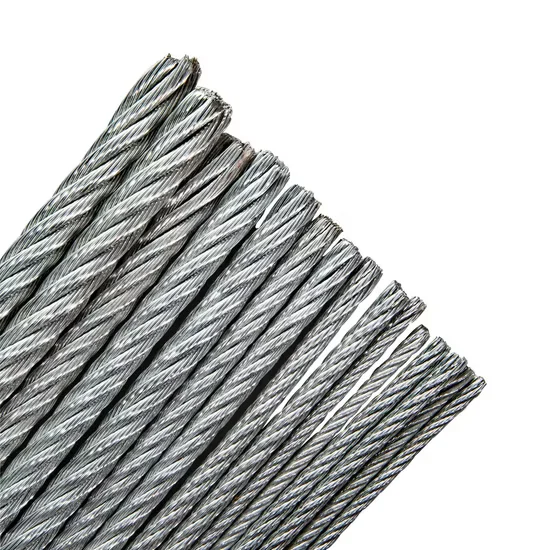
The application determines the treatment
Steel wire rope combines strength with flexibility, which is why it appears in lifting and rigging, load securement, marine work, guy wires, bridge and building support, fencing, winches, ropeways, and stone-cutting systems. The right finish depends on where the rope will operate and how it will wear.
Bright, uncoated rope remains common in heavy hoisting and high-abrasion service, where repeated contact can wear zinc away. Stainless steel is generally preferred for the most aggressive saltwater or chemical exposure. Galvanized rope covers the broad middle ground: it keeps the strength and flexibility of steel while adding zinc protection at a more moderate cost than stainless steel.
But “galvanized” is not a complete specification. Electro-galvanized and hot-dip galvanized rope can share the same diameter and construction while differing materially in corrosion resistance, surface finish, stiffness, weight, and price. A buyer comparing quotes should confirm the process, zinc coating requirement, construction, core, lay, strength grade, and governing standard.
Wire rope itself is built from fine steel wires twisted into strands, with the strands laid helically around a core. Sharing load across many wires gives the finished rope its useful combination of strength and flexibility; the exact construction controls bending performance, abrasion behavior, and load capacity.
Electro-galvanized vs. hot-dip galvanized wire rope
Both processes use zinc to protect the underlying steel, but they produce different coatings. Zinc provides a barrier and sacrificial protection: it corrodes preferentially to steel, so nearby zinc can continue protecting the base wire around minor scratches. In specific structural applications, properly specified zinc-coated strand and rope have remained in service for more than 75 years. That is evidence of what a complete system can achieve—not a universal service-life promise for every rope.
Electro-galvanizing deposits zinc from a solution using electrical current. The result is a thin, smooth, bright, and precisely controlled coating. It is usually the lower-cost choice for indoor work, short-duration field use, and applications where a clean appearance matters more than long corrosion life.
Hot-dip galvanizing immerses cleaned wire in molten zinc at roughly 450–480°C. A thermal reaction forms iron-zinc alloy layers metallurgically bonded to the steel, topped by a layer of zinc. Industry references commonly describe the finished coating as 5–10 times thicker than electro-galvanized cable. On wire products, cited coating thicknesses range from about 45 microns to more than 300 microns, depending on wire diameter, standard, and process.
That additional zinc makes hot-dip galvanized rope the stronger choice for weather, humidity, salt, and many caustic environments. The trade-offs are a duller and sometimes uneven finish, added weight and stiffness, and a price premium that can reach roughly 40% over comparable electro-galvanized rope.
| Factor | Hot-dip galvanized | Electro-galvanized |
|---|---|---|
| Coating | Thicker zinc and alloy layers with strong adhesion | Thin, smooth, controlled zinc deposit |
| Typical choice | Outdoor, wet, marine, and corrosive exposure | Indoor, lighter-duty, or finish-sensitive use |
| Appearance | Dull and sometimes uneven | Bright and uniform |
| Trade-offs | Added weight and stiffness; comparable rope may cost up to roughly 40% more | Less corrosion life, but a lower-cost and smoother finish |
Sources: Mazzella Companies, Fehr Bros., and ASTM A475.
Coating classes require care
For structural strand and rope, standard hot-dip galvanizing provides a Class A coating in the cited guidance. Class B is twice and Class C three times the Class A coating weight, but that guidance says the heavier coatings are applied electrolytically. Related standards—including ASTM A363, A475, A586, and A603—use class systems with product-specific minimums. Always quote the exact standard, wire diameter, and required zinc mass rather than treating “Class C” as a universal shorthand.
Where hot-dip galvanized wire rope is used
Hot-dip galvanized rope is most useful where steel cable faces weather, moisture, or salt for long periods—especially in static or lower-abrasion service where the zinc layer is not continually worn away.
Marine and coastal
Ship rigging, mooring lines, stays, and construction rigging exposed to salt and moisture.
Infrastructure
Guy wires for towers and poles, suspension-bridge strands and hangers, and aerial ropeway or track cables.
Agriculture
Fencing, barbed wire, vineyard wire, and other weather-exposed tension members.
Outdoor handling
Winches, pulley systems, lifting, and pulling where the selected rope is engineered for the load and duty cycle.
The galvanized finish addresses corrosion; it does not determine load capacity or suitability by itself. Final selection still depends on rope construction, strength grade, bending and fatigue requirements, terminations, inspection rules, and the applicable safety standard.
Hot-dip galvanized carrier rope in diamond wire saws
Stone quarrying gives galvanized rope a specialized role. A diamond wire saw is a loop of compact steel carrier rope strung with diamond-impregnated beads and driven around a block or quarry bench. The rope carries machine tension and moves the beads through the cut; the beads remove the stone. Zinc protects the fine steel wires from cooling water and slurry, while coating consistency affects how reliably beads, crimps, and injected plastic or rubber grip the rope.
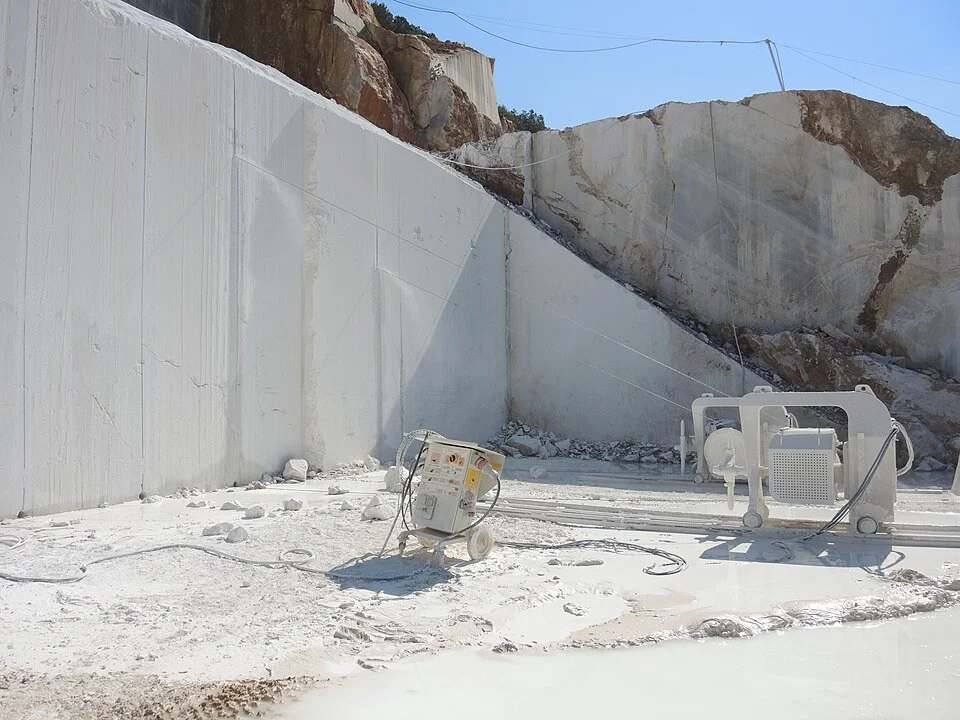
Carrier rope is braided from many fine galvanized wires—commonly 61 to 133 wires—into a compact, high-tensile rope. The ranges below are examples reported by wire-saw suppliers, not a universal specification.
| Parameter | Quarry wire | Multiwire / profiling |
|---|---|---|
| Rope diameter | Approximately 4.8–5.0 mm | Approximately 2.0–3.5 mm |
| Example constructions | 6×7+1×19, 7×19, 133-strand | 7×7 and similar compact constructions |
| Typical tensile grade | Up to about 2160 MPa | About 1870–2160 MPa |
| Bead diameter | About 10.5–11 mm | About 6–8.8 mm |
| Beads per meter | 27–40 | 33–40 |
Buyers should explicitly confirm hot-dip versus electro-galvanized coating and request coating weight in g/m². Fine wires may otherwise be quoted with electro-galvanizing by default. For the complete cutting assembly, applications, and RFQ inputs, see the diamond wire saw sourcing guide.
Diamond beads, assemblies, and cutting applications
Each diamond bead—sometimes called a “pearl”—starts with a bored steel sleeve that slides over the carrier rope. A cutting ring of synthetic industrial diamond grit is held around the sleeve in a metal matrix. Bead manufacturers buy the diamond grit and embed it during production; buyers of finished wire normally specify the bead and assembly rather than sourcing loose diamond.
Sintered
Diamond and metal powder are hot-pressed into a cutting ring. Usually selected for longer life in quarrying and block work.
Electroplated
A single layer of diamond is bonded to the sleeve. These beads cut aggressively but have a different wear profile.
Vacuum-brazed
Often used for dry cutting of softer stone such as marble and limestone.
Bond hardness is matched inversely to stone behavior: softer bonds can be used for softer, less abrasive stone such as many marbles, allowing the matrix to wear back and expose fresh diamond. Reputable manufacturers tune binder, grit size, and concentration to the material, sometimes after laboratory analysis of quarry samples.
The synthetic diamond is commonly produced by the high-pressure, high-temperature process. The memo’s market sources estimate China at roughly 40–50% of global synthetic diamond output, centered in Henan Province, with producers including Zhongnan Diamond and Henan Huanghe Whirlwind; Element Six, part of the De Beers Group, is a major producer elsewhere. These market-share estimates vary by source and should be treated as directional.
Beads are spaced by springs, injected plastic, or injected rubber, with crimps and connectors completing the loop. Spring assemblies suit softer stone such as marble and limestone. Plastic or rubber injection protects the rope from slurry abrasion and is used for harder or more abrasive cutting.
Assembled diamond wire is used for quarry extraction, freeing and squaring blocks, multiwire slabbing, and profiling shaped stone. Heavier rubber-and-spring systems also cut reinforced concrete and steel in demolition, bridge, and underwater work. The method can cut in multiple directions with a narrow kerf, low noise and dust, and relatively little material loss—important with high-value marble.
How to specify and source the product
Carrier rope and diamond beads often come from different specialists. Examples in the research memo include wire-rope mills such as Fasten Group and Jiangsu Zhongying in China and Mollificio Apuano in Italy’s Carrara district. Bead and assembled-wire manufacturers include Dellas and Boart & Wire in Italy and Dialead, ChinShine, Wanlong, and Huazuan in China. These names are starting points for supplier evaluation, not endorsements.
- Application and operating environment
- Rope, strand, carrier rope, beads, or full assembly
- Rope construction and nominal diameter
- Tensile grade and minimum breaking requirement
- Hot-dip process and zinc coating weight
- Core, lay, lubrication, and end termination
- Reel length, quantity, packaging, and labeling
- Mill certificate, coating report, and inspection
- Stone type and bead diameter/bore/bond
- Grit size, concentration, beads per meter, assembly method
- Delivery address or port and required date
- Requested Incoterm and landed-cost comparison
Request the exact product, delivered
Send the product specification, quantity, and destination. Mati compares supplier and forwarder combinations and shows the supplier, freight, customs, timing, and final-delivery costs behind each landed quote.
Questions about galvanized steel wire rope
Is galvanized steel cable the same as galvanized steel wire rope?
The terms are often used interchangeably in commercial searches. In technical use, wire rope usually describes multiple wire strands laid around a core, while cable can be used more broadly. Put the required construction and standard in the RFQ rather than relying on the name alone.
Is hot-dip galvanized wire rope better than electro-galvanized rope?
It is generally the stronger choice for corrosion resistance because the zinc coating is thicker. Electro-galvanized rope may be appropriate where a smoother finish, tighter coating control, lighter exposure, or lower cost is more important.
What coating class should I request?
Use the class required by the governing standard and exposure. ASTM A475 includes Class 1 and Classes A, B, and C for zinc-coated steel wire strand. Ask for the exact coating mass and test report rather than choosing a class without confirming product scope.
Can Mati source wire rope for a diamond wire saw?
Mati can source against your carrier-rope or finished-assembly specification and compare supplier and delivery options. Include the stone, rope diameter and construction, tensile requirement, coating, bead details, quantity, and destination.
Does Mati manufacture the wire rope?
No. Mati finds and compares suppliers and forwarders, then coordinates the selected purchase through delivery.

.svg)
.svg)

